Buying Used Tyres by the Container: Grades, Loading and Paperwork
Grade bands, how many tyres really fit in a 20FT or 40FT, and why the re-use versus waste distinction decides whether your container clears customs. Written for buyers placing their first container order.
Most disputes over a used tyre container do not start with the price. They start when the container is opened and the buyer counts a different mix of sizes, grades or quantities than the one in their head when they confirmed the order. Almost all of it is avoidable, and almost all of it comes down to three things agreed badly: what the grade means, how the container was loaded, and which customs heading the goods travel under.
This is a practical walk through those three, in the order they tend to bite.
Grades are a private language, so pin them down
There is no international standard that defines a used tyre “Grade A”. Every exporter runs its own scale, and the same letter can mean materially different goods from two suppliers in the same city. A grade letter on a proforma invoice, with nothing behind it, is not a specification — it is a label.
What makes a grade mean something is the tread depth band written beside it. Our own used tyre pages publish the bands we sort to:
| Grade | Remaining tread depth |
|---|---|
| A+ | 7 mm or more |
| A | 6.0 – 6.9 mm |
| B | 5.0 – 5.9 mm |
| C | 4.0 – 4.9 mm |
Those numbers are the part worth arguing about. Ask any supplier for the millimetre band behind their letters before you discuss price, and get it onto the contract. If a supplier will not put a band in writing, you are not buying a graded product.
Two further points that catch first-time buyers:
Tread depth is measured, not estimated. The measurement is taken in the principal grooves with a depth gauge. A tyre is rarely worn evenly, so what matters is whether the band refers to the shallowest groove or an average across the tread. Shallowest is the conservative reading and the one worth specifying.
Destination minimums override your grade choice. Many countries set their own legal minimum for part-worn tyres offered for sale, and some set a higher bar for imports than for domestic resale. A grade that is perfectly saleable in one market can be unsaleable in the next one along. Check the rule in your market before you pick a band, not after.
Beyond depth, the things that decide whether a tyre is actually resaleable are condition
faults, not wear: sidewall cuts, bead damage, exposed cords, repairs, uneven wear patterns
suggesting an alignment fault, and age. The DOT code moulded into the sidewall gives the
week and year of manufacture in its final four digits — 3519 is the 35th week of 2019.
Decide what maximum age you will accept and say so in the order, because a 4 mm tyre from
last year and a 4 mm tyre from eight years ago are not the same product even though they
share a grade.
How many tyres actually fit in a container
This is the question buyers ask first and the one where published numbers vary most wildly, because people quote different things as if they were the same.
For used passenger car tyres, the figures we use for planning are:
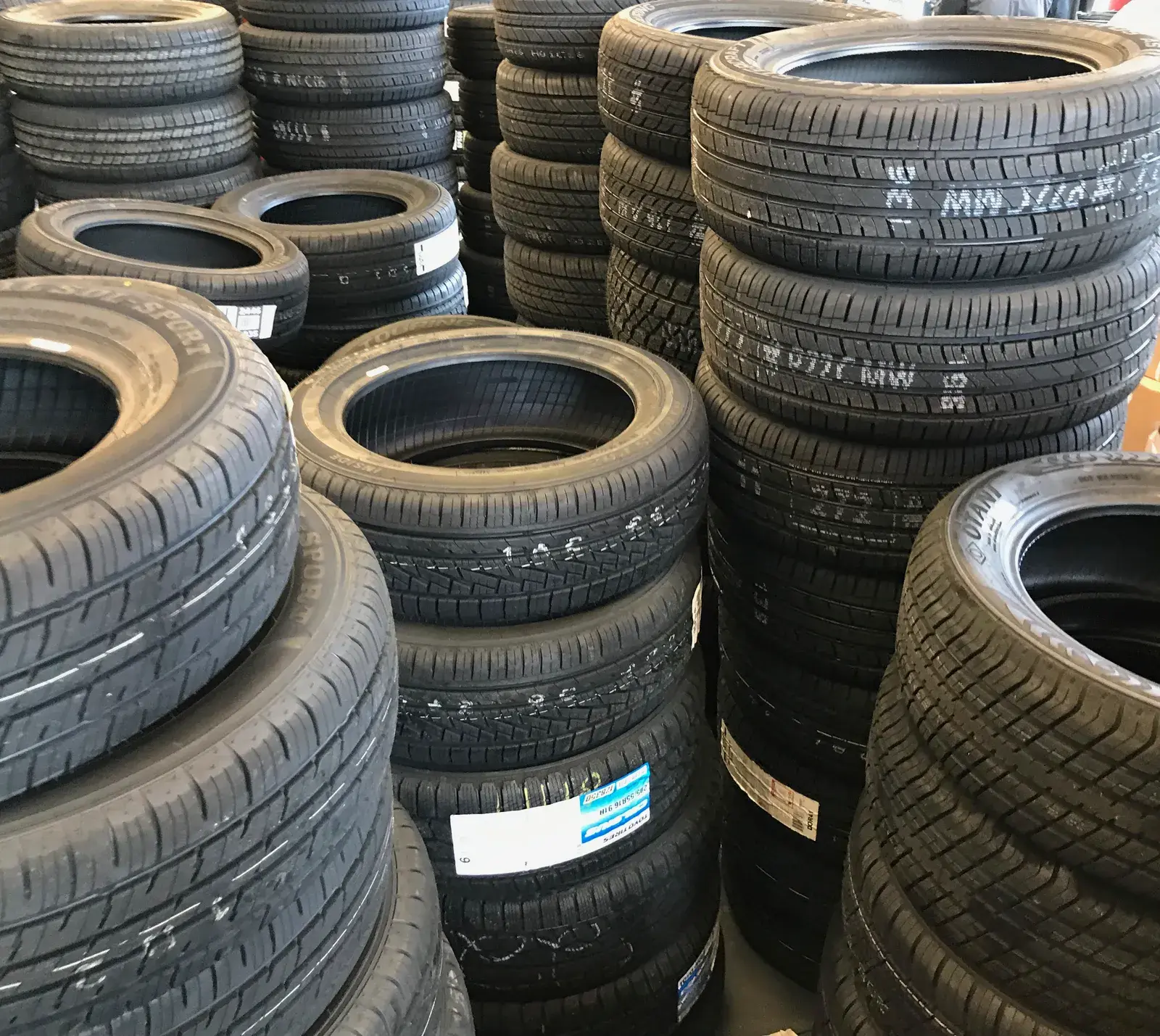
- 20FT container: approximately 1,000 – 1,500 tyres
- 40FT container: approximately 2,000 – 3,000 tyres
Those are estimates for planning a purchase, not measured capacities or a guarantee. The final figure is confirmed in the quotation and the loading plan, because the spread is real and it is driven by two variables.
Size mix. A container filled with 13- and 14-inch tyres holds dramatically more pieces than one filled with 18-inch SUV tyres. If you order “mixed sizes” and then budget on the top of the range, you have mispriced your own container. Agree the size mix, or agree the piece count, but do not assume one from the other.
Loading method. Loose-loaded tyres thrown in and stacked by hand fill the space differently from tyres that are doubled — one pressed inside another — or tripled. Doubling and tripling raise the piece count significantly and also raise the labour cost of loading and unloading. A quote of “3,000 pieces per 40FT” almost always implies doubling or tripling; a quote of 2,000 usually does not. When you compare two offers, check you are comparing the same loading method before you conclude one is cheaper.
Weight is the other constraint, and it binds earlier than people expect on truck tyres. A passenger car tyre is light enough that a 40FT fills on volume long before it hits a payload limit. Truck and bus tyres are heavy enough that you can reach the container’s maximum gross weight with the box visibly half empty, so piece counts for truck tyres are far lower and are a weight calculation, not a volume one.
Our published minimum order for used tyres is 1,200 tyres, and mixed sizes, brands and grades are accepted subject to confirmation. Loading is loose or bundled, sorted by size and grade. The practical reason sorting matters: a container that arrives sorted can be inventoried in hours. One that arrives as an unsorted mass costs you days of labour before you know what you actually bought.
The paperwork decides whether it clears
This is the part that turns a good purchase into a stranded container, and it rests on a distinction that is easy to miss.
Re-use versus waste
Customs and environmental authorities treat used tyres as two entirely different things depending on what will happen to them:
- A used tyre destined for direct re-use or retreading is a product.
- A used tyre that cannot be re-used or retreaded is waste, and waste moves under a far more restrictive regime.
The Basel Convention’s technical guidelines on used tyres set out this distinction and note that most countries accept imports of used tyres intended for re-use or retreading while refusing those that cannot be re-used or retreaded (Basel Convention technical guidelines). In practice this means a shipment of genuinely resaleable part-worn tyres and a shipment of casings headed for shredding are different transactions with different documentation, even if they look similar on a packing list.
Grading does the work here. Tyres sorted to a stated tread band, with condition faults removed, are evidence of intended re-use. An unsorted mixed load with no grading is much harder to present as anything other than waste.
Customs classification
Tyre classification under the Harmonized System splits cleanly:
- HS 4011 — new pneumatic tyres of rubber
- HS 4012 — retreaded or used pneumatic tyres of rubber, solid or cushion tyres, tyre treads and tyre flaps
Used and retreaded tyres fall under 4012, and within it there are separate subheadings for retreaded versus used. Getting this heading right matters beyond duty: many national import restrictions on tyres are written against specific 4012 subheadings, so the classification determines which rules apply to your shipment. Confirm the exact subheading and the destination’s requirements with your customs broker before booking — restrictions vary sharply between countries and change more often than most product rules.
Retreads are a separate category
If you are buying retreaded rather than part-worn tyres, a different framework applies. Retreaded tyres sold into markets that follow UN ECE rules need type approval under UN Regulation No. 108 (retreaded pneumatic tyres for passenger cars and their trailers) or UN Regulation No. 109 (retreaded tyres for commercial vehicles and their trailers). Both were adopted under the 1958 Agreement and entered into force in 1998, and both govern the approval of retread production rather than individual tyres — so the question to ask a retread supplier is which approval their plant holds, and for which tyre categories. The texts are published by UNECE’s World Forum for Harmonization of Vehicle Regulations (WP.29).
Part-worn tyres are not retreads and do not carry these approvals. Suppliers occasionally blur the two. They are different goods with different compliance.
The documents themselves
A used tyre shipment normally travels with a commercial invoice, a packing list and a certificate of origin, plus whatever inspection or pre-shipment certificate the destination requires. Some markets require a pre-shipment inspection by a nominated agency, and arranging that after the container is sealed is expensive. Establish whether your destination requires one before loading.
Specifying an order so it arrives as expected
A used tyre order that will not surprise anyone contains, in writing:
- Grade letters with their tread depth bands in millimetres, and whether depth is read at the shallowest groove or averaged.
- The size mix — either the specific sizes and quantities, or an agreed proportion by rim diameter.
- Maximum age, expressed as a DOT year.
- Condition exclusions — no sidewall damage, no exposed cord, no plug repairs, whatever your market will not take.
- Loading method — loose, doubled or tripled — and the resulting piece count.
- Piece count or container count, and which of the two is the binding figure.
- Incoterm and destination port.
- The sorting standard on arrival — sorted by size and grade, or bulk.
Points 1, 5 and 6 are where most disagreements live. Agreeing them costs one email.
Frequently asked questions
Is there an international standard for used tyre grades? No. Grade letters are supplier-specific. The tread depth band behind the letter is the only part that transfers between suppliers, which is why it belongs in the contract.
How many used tyres fit in a 40FT container? For passenger car tyres, roughly 2,000 – 3,000 as a planning figure, depending on the size mix and whether tyres are loose, doubled or tripled. Truck tyres are far fewer and are limited by weight rather than volume.
What tread depth should I ask for? It depends on your market’s legal minimum for resale and on what your customers expect. Buy above the legal minimum with margin, since tyres sitting at exactly the limit are difficult to sell and may not be legal to offer at all.
Can I mix sizes, brands and grades in one container? Yes, subject to confirmation. Specify the mix rather than leaving it open, and specify whether the load arrives sorted.
Do used tyres need UN ECE approval? No — UN Regulations 108 and 109 apply to the production of retreaded tyres. Part-worn tyres are a different product. Destination-specific import rules still apply.
What HS code do used tyres travel under? Heading 4012 covers retreaded and used pneumatic tyres. Confirm the exact subheading with your broker, because import restrictions are often written against specific subheadings.
How is the age of a tyre determined?
From the DOT code on the sidewall. The last four digits give the week and year of
manufacture — 2621 means week 26 of 2021.
Where to start
If you are costing a first container, the two figures to establish before anything else are the tread depth band behind the grade and the piece count the supplier is actually committing to. Everything else follows from those.
We publish our grading bands, loading estimates and minimum order quantity openly on the used tyres pages, alongside new tyres from 28 brands with their EU label data in the car tyres catalogue. If you would like a specific mix costed, send the sizes, grades and destination port through the quotation form and we will come back with a loading plan and a price.
Figures for grading bands, loading estimates and minimum order quantity are our own published terms and are confirmed per order. Regulatory requirements vary by destination and change; confirm them with your customs broker for your specific market.